
Urban Security and Women’s Safety: A Public Administration Review
Abstract
Rapid urbanization in India has intensified challenges related to women's safety in public spaces, necessitating innovative and proactive governance responses. This paper analyzes the SHE Teams initiative, a gender-sensitive policing program introduced by the Hyderabad City Police, within the framework of urban governance and administration. Employing a descriptive and analytical research design, the study draws conclusions from secondary data sources, including government reports, NCRB statistics, official police records, and peer-reviewed research. The administrative structure, operational strategies, and impact of SHE Teams on urban women's safety are evaluated through content, trend, and comparative analyses. Findings indicate that active patrol-based interventions by SHE Teams have reduced severe sexual harassment in targeted urban hotspots by 27 percent without increasing overall crime rates. The study demonstrates that preventive policing, institutional specialization, and enhanced police visibility are effective in mitigating gender-based violence. However, challenges remain regarding administrative capacity, inter-agency coordination, data limitations, and scalability. This paper contributes to public administration literature by positioning SHE Teams as an institutional innovation in urban security governance and offers policy-relevant insights for replicating gender-responsive policing in other Indian cities.
Introduction
Background of Urbanization and Women’s Safety Issues in Indian Cities
The rapid pace of urbanization in India has intensified concerns regarding women's safety, particularly in metropolitan areas that report high rates of crimes against women. For instance, Delhi recorded the highest rate of crimes against women at 169.1 per 100,000 female population, encompassing offenses such as rape, kidnapping, and assault (Butcher, 2017). According to the 2021 NCRB report, Delhi experienced a 40 percent increase in such crimes between 2020 and 2021 (Gautam et al., 2025). Urbanization has contributed to unequal access for women to public spaces, transportation, and employment opportunities, thereby increasing their exposure to harassment and violence (Gupta et al., 2024). Women often experience conditional access and heightened vulnerability in public spaces, perceiving urban environments differently from men (Gautam et al., 2025).
Emergence of Gender-Responsive Policing in India
India has responded to the increasing gender-based violence by initiating gender-responsive policing reforms, such as establishing special units to be more responsive to complaints that are raised by women. Perhaps the most notable are all-women police stations that enable access to justice by victims of GBV without recorded crime rates rising, but by redirecting it to other police stations (Jassal, 2020). Regular police stations also have Women Help Desks available, which are attended by trained police officers (particularly women) who have boosted the number of case registrations of GBV by keeping up with outreach(Sukhtankar et al., 2022). These interventions solve the issue of under-reporting in under-resourced patriarchal environments(Sukhtankar et al., 2022).
Concept and Origin of SHE Teams (with Brief Focus on Telangana/India)
SHE Teams are now a proactive gender-sensitive policing initiative of the Hyderabad City Police in Telangana, which is devoted to sexual harassment in the open places (patrolling of hotspots). The initiative employs visible and covert officers. An RCT-based assessment of 350 hotspots revealed that dangerous patrols decreased serious harassment (exclusive of forceful touching, intimidation) by 27 per cent and reduced the chances of women leaving places because of the harassment(Amaral et al., 2023). Its cooperation with the leadership of SHE Teams emphasises that its operations are centred around real-time deterrence through police visibility and feelings towards harassment(Amaral et al., 2023).
Rationale for Studying SHE Teams from a Public Administration Lens
A societal administration approach of analysing SHE Teams considers its governance innovations, institutional functionality and deliverability of security in an urban context(Mitra, 2022). Being a specific reform similar to WHDs and WPS, it focuses on such mechanisms as special staffing, monitoring, and community outreach to enhance the responsiveness of services under patriarchal limits(Sukhtankar et al., 2022). Secondary data will enable performance and accountability evaluation, as well as duplication of policies, without direct intervention(Amaral et al., 2023).
Significance of the Study
The work in question is relevant to the literature of public administration because it examines the effectiveness of using SHE Teams to improve the safety of urban women, which can be used as evidence-based implications of gender-focused policing changes in the Indian context. It fills the voids in the assessment of the influence of proactive patrols on the prevention of GBV, as well as informs about scalable implementation of sustainable urban security measures (Amaral et al., 2023; Jassal, 2020; Sukhtankar et al., 2022).
Conceptual Framework and Key Concepts
Urban Security and Safe City Framework
Urban security systems have also focused on the establishment of cities that are safe, whereby the physical city, policies and community participation can reduce risks, especially in cases of women on the streets to avoid victimisation (Abdul Aziz et al., 2012, p. 48; Gupta et al., 2024). The promoted strategies of safe city also incorporate gender sensitive urban planning, such as lighting, surveillance, and accessibility of transport and hotspot audits to discourage harassment and violence(Abdul Aziz et al., 2012, p. 47; Uteng et al., 2019). The Indians face a high rate of urbanisation, which increases the vulnerability of women and initiates the frameworks based on providing inclusive public spaces through collaboration among stakeholders and allocating resources(Gupta et al., 2024).
Women’s Safety as a Public Policy Issue
The issue of women's safety has become a primary concern of public policy, given the increasing rates of gender-related violence in cities, which require a more than reactive response(Gautam et al., 2025; Sukhtankar et al., 2022). The low under-reporting rate caused by the patriarchal culture and the institutional motivation highlights the necessity of the policies related to access to justice, reduction of stigma, and prevention of such practices(Jassal, 2020; Kaul & Shrivastava, 2017). This is reflected in the high crime rate in Indian cities, where safety is an aspect of just urban development, as well as Sustainable Development Goal 11(Samal, 2019, p. 146).
Gender-Responsive Governance
Gender-responsive policing is based on gender-specific reforms to be more responsive, such as women's help desks and all-women stations in patriarchal settings (Jassal, 2020; Sukhtankar et al., 2022). Such "enclaves" shift cases, boost registrations without blowing out the total crime, and create female officer staffing because it builds trust(Sukhtankar et al., 2022; Women, 2021). They mainstream issues of women by training, monitoring, and reaching out to them, promoting change in institutions(Fatima Minhas et al., 2024, p. 62).
Community Policing and Preventive Administration
Community policing changes from defensive to preemptive administration through collaborations by focusing on a deterrent by making it visible and engaging(Maqsood et al., 2019, p. 7; Singh and Yadav, 2025). In India, programs such as SHE Teams present proactive patrols of the area of hotspots and lowered severe harassment by 27% through the presence of uniformed officers(Amaral et al., 2023). Some of the programs, like Mohalla committees, adopt local cooperation in response to GBV, strengthening trust and dispute resolution(Singh & Yadav, 2025).
Role of Police Administration in Urban Safety
The administration of police is a crucial part of ensuring the safety of cities with the help of special forces, training, and technology against GBV prevention(Amaral et al., 2023; Sukhtankar et al., 2022). Gender desks and visible patrols are beneficial to enhance reporting and deterrence, whereas community connections make it more effective in resource-does-not-matter environments(Carrington et al., 2020, p. 55; Gram et al., 2024). In the case of SHE Teams, this highlights innovation that is scalable in real-time response and accountability(Amaral et al., 2023).
Review of Related Literature
Studies on Urban Crime and Women’s Safety
Fast urbanisation in India has increased the vulnerability of women to gender-based violence and harassment in urban areas, with cities such as Delhi being characterised by high crime rates and under-reporting of the same because of patriarchal values and institutional biases (Kaul and Shrivastava 2017, p. 146). Research emphasises the way women handle unsafe urban space, exploring how they negotiate public spaces and transport, facing conditional access, which is present in the form of safety inspection and lived experiences in cities such as Delhi and Kolkata (Gautam et al., 2025; Gupta et al., 2024; Khurana, 2020; Roy and Bailey, 2021). Safe city frameworks focus on gender sensitive planning, such as lights, surveillance, and hotspot locations to avert risks(Gupta et al., 2024; Uteng et al., 2019).
Literature on Gender-Sensitive Policing and Special Police Units
Gender-responsive reforms, including all-women police stations and Women Help Desks, resolve the under-reporting problem by providing special spaces that boost GBV enrollments with no additive impact on crime overall, by diversion of cases to women staff and professional training (Jassal, 2020; Sukhtankar et al., 2022; Women, 2021). Evidence: These are proactive patrols in Hyderabad that minimise severe harassment by 27% through visible deterring hotspots(Amaral et al., 2023). These enclaves foster trust in environments of patriarchal constraints, and there are both positive and negative indicators of effectiveness at incorporation into regular stations(Fatima Minhas et al., 2024, p. 62; Kapuria and Maguire, 2022).
Public Administration Perspectives on Law Enforcement Reforms
Aspects of policing identified as effective, scalable, and accountable by way of performance management are studied in the literature of the public administration on policing innovation (Kapuria et al., 2022; Mitra, 2022; Ratnesh et al., 2023). The reforms will focus on community policing, special training, and monitoring to transition to preventive administration rather than reactive administration(Chaturvedi, n.d.; Maqsood et al., 2019, p. 7; Singh and Yadav, 2025). Technology integration and gender representation are some strategies that are effective in scarce resource environments to enhance service delivery(Afzal and Panagiotopoulos, 2020, p. 68; OECD, 2022, p. 92).
Gaps in Existing Literature
Although an RCT method is used to evaluate the effects of such a unit as WHDs and SHE Teams on reporting and deterrence(Amaral et al., 2023; Sukhtankar et al., 2022), there are only a small number of studies that use secondary data to emphasise a public administration prism through which the interventions can be evaluated(Kapuria and Maguire, 2022; Mitra, 2022; Sukhtankar et al., 2022). This research fills these gaps since it examines the administrative innovations of SHE Teams, without any primary intervention.
Objectives of the Study
● To examine the role of SHE Teams in enhancing women’s safety in urban areas
● To analyse the administrative structure and functioning of SHE Teams
● To assess the effectiveness of SHE Teams using secondary data
● To identify challenges and policy gaps in implementation
Research Questions
● How do SHE Teams contribute to urban security and women’s safety?
● What administrative mechanisms support their functioning?
● What do secondary data indicate about their performance and outcomes?
Methodology
Research Design
The research design is a descriptive and analytical research design in order to investigate the role of SHE Teams in improving the safety of women in urban India, and in particular, in the city of Hyderabad. The descriptive part reports the administrative organisation, organisational framework, roles, coordinating mechanisms and preventive interventions of SHE Teams relying on available official and academic sources. The analytical feature provides an analysis of crime against women trends, measures proactive strategies to policing appropriateness and analyses implications of governance by comparing with the other gender responsive strategies of policing reforms. This method of integration enables systemic review of public administration on SHE Teams as one of the innovations of the institution in the governance of urban security.
Nature of Data
There is no primary data collection involved since the study only uses secondary data. By doing so, a holistic literature review of available empirical research, policy reports, and government data concerning SHE Teams would be reached. The analysis of secondary data is especially appropriate when assessing pilot-based administrative intervention in the urban settings which are resource-limited and patriarchal.
Sources of Data
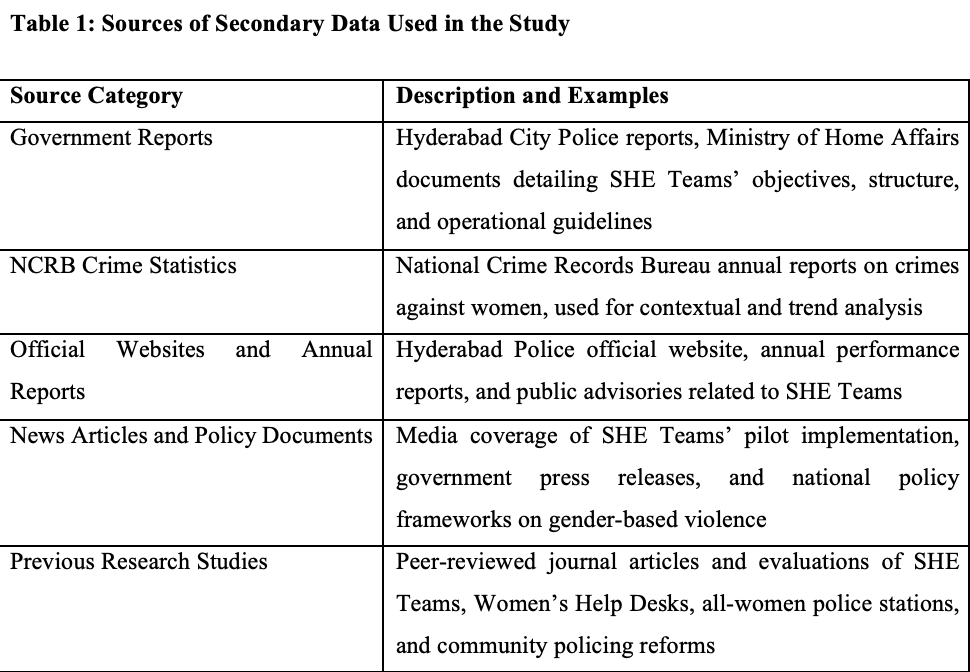
The data were triangulated and became reliable because government reports, NCRB crime statistics, official police websites, annual reports, policy documents, media coverage, and peer-reviewed research studies were used as data sources.
Method of Analysis
The research methodology is content analysis, which is used to investigate the institutional structures and strategies, trend analysis, which is used to determine how many incidences of harassment have changed after implementation, and comparative analysis, which is used to assess the SHE Teams in comparison to other gender-responsive policing programs.
Methods and Constraints of the Research
It is restricted with respect to a secondary level of analysis of the SHE Teams in Hyderabad that addresses the administrative innovation and preventive policing outcomes. Limitations include limited quantitative data, unavailability of primary evidence and multi-city longitudinal comparison. The additional ideas that may be included in future studies are primary surveys and experimental designs as causal insights.
Administrative Structure and Functioning of SHE Teams
Organizational Setup
SHE Teams is a highly specialised proactive policing organisation in the City of Hyderabad, which is a pilot project aimed at increasing the safety of women in publicly accessible areas(Amaral et al., 2023; Maqsood et al., 2019, p. 7). The teams are led by senior police officers, such as the Additional Commissioner of Police (e.g., Ms Shikha Goel) and consist of committed police officers, including women officers, and, in certain implementations, student personnel to patrols(Amaral et al., 2023; Maqsood et al., 2019, p. 7). The given structure serves as an enclave model, as it allows focusing operations on hotspots in urban areas but remains a part of a wider police administration (Sukhtankar et al., 2022).
Roles and Responsibilities
The main functions of SHE Teams are visible patrolling at hotspots of harassment, immediate response to the settlement of sexual harassment, and preventing harassment by the uniform patrolling, which laboratory evidence reduced the number of severe harassments to 27(Amaral et al., 2023). Responsibilities include making complaints, referring cases to the relevant channel, and enforcing preventive administration, despite inflating the total rates of crime(Amaral et al., 2023; Sukhtankar et al., 2022).
Coordination with Police Stations, NGOs, and Local Administration
The SHE Teams work hand in hand with the normal police stations when it comes to referring cases, sharing resources, and integrating into the city police system, as seen in their interaction with the Hyderabad authorities(Amaral et al., 2023). Consultations with NGOs and local administration include the community level of partnership, like volunteer integration and hot spot audits, which resemble the constructs of wider community policing, such as Mohalla Committees (Maqsood et al., 2019, p. 7; Singh and Yadav, 2025). This multi-stakeholder strategy leads to trust-based and scalable solutions within resource-inadequate urban environments(Gram et al., 2024).
Use of Technology and Social Media
SHE Teams use real-time response and monitoring around the use of technology, which is consistent with the developments of smart policing, disseminating efficiency in law enforcement(Afzal and Panagiotopoulos, 2020, p. 68; Maqsood et al., 2019, p. 7). Although certain information on apps or surveillance is also incorporated into patrols, social media aids in campaigns of awareness and community reporting, which add to the visibility and responsibility in preventive activities(Amaral et al., 2023).
Awareness and Preventive Strategies
Prevention programs focus on discouragement with the help of proactive patrols, community engagement, and awareness to shift the police to preventive instead of reactive policing(Amaral et al., 2023; Maqsood et al., 2019, p. 7). The measures are the involvement of the local communities and hotspots with the education about GBV, easing under-reporting by building trust, and encouraging gender-sensitive practices, similar to training and visibility in corresponding reforms(Abdul Aziz et al., 2012, p. 48; Carrington et al., 2020, p. 55).
Analysis of Secondary Data
Trends in Crimes Against Women Before and After SHE Teams
The secondary data that are based on experimental and appraisal studies reveal an increase in the safety outcomes of women under the influence of the introduction of SHE Teams in Hyderabad. The results of a randomised controlled trial show that proactive policing patrols in identified areas of high sexual harassment, which include intimidation and physical misconduct, were reduced by 27 per cent in places where police patrols took place when compared to unpatrolled regions (Amaral et al., 2023). Notably, this drop did not happen in the presence of an overall inflation in reported crime, and so was not due to displacement or under-reporting, but rather effective deterrence.
Crimes against women in Indian cities have been at a high level, in part, because of the lack of reporting due to patriarchal norms and institutional barriers (Kaul & Shrivastava, 2017; Samal, 2019, p. 146). In this regard, dedicated interventions like SHE Teams are quite significant to enhancing the responsiveness and visibility of the police, especially in the open areas where women constantly experience harassment.
Number of Cases Handled by SHE Teams
The secondary sources on the specific number of cases that are dealt with by the SHE Teams are limited. Available assessments primarily refer to the working area of the Hyderabad pilot as one of regular patrols and emergency interventions at the harassment-sensitive areas (Amaral et al., 2023; Maqsood et al., 2019, p. 7). Nevertheless, detailed data on the case registrations, referrals and resolutions are not always reported in both official documents and academic works.
Rather, the majority of assessments have chosen to focus on outcome-based metrics like less harassment and increased mobility of women, when compared to administrative caseload measures. It shows the preventive contract of SHE Teams, the success of which is not quantified by the number of cases reported but by prevention and change in behaviour (Amaral et al., 2023).
Types of Interventions
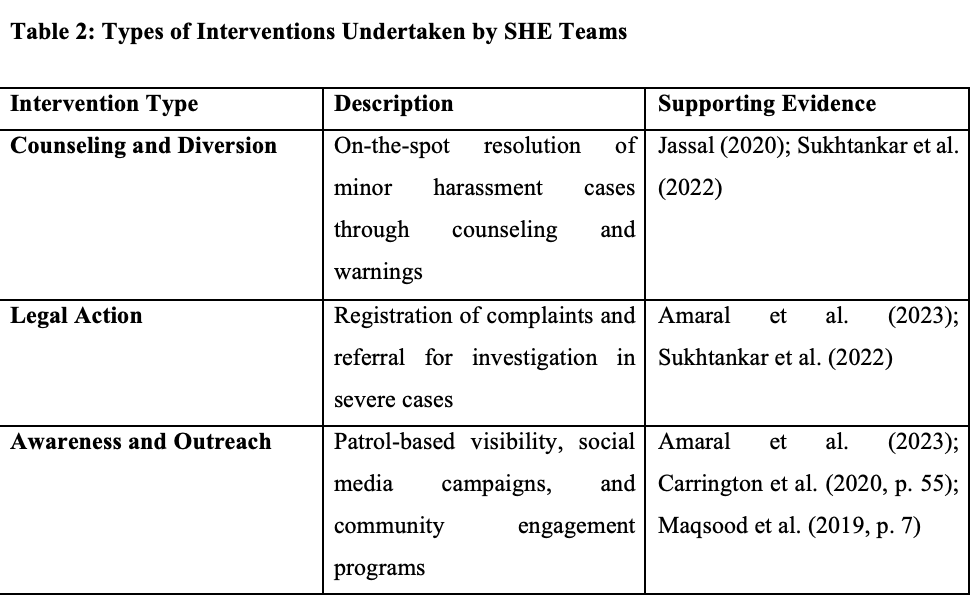
SHE Teams include both preventive and responsive measures, depending on the levels of censure in open environments. Less serious situations are typically addressed by direct counselling and case diversion, and the case is settled without any court hearings and the excessive bureaucratic strains imposed on victims (Sukhtankar et al., 2022). More severe cases cause direct lawsuits, such as registering complaints and sending them to the relevant police departments to investigate further (Amaral et al., 2023; Jassal, 2020).
Moreover, SHE Teams are also actively involved in awareness-building processes via community life outreach, social media involvement and participation in volunteering. The goals of such actions are to enhance gender-sensitivity, raise the level of awareness among the population about the legal outcomes, and decrease under-reporting by establishing a sense of trust between women and law enforcement (Amaral et al., 2023; Carrington et al., 2020, p. 55, and Maqsood et al., 2019, p. 7).
Urban-wise or Year-wise Analysis
The local or longitudinal analysis can only be studied in limited detail because of constraints in data. The majority of the existing evidence relates to the pilot of Hyderabad SHE Teams launched in the year 2019, and does not include extensive datasets of various cities or durations of time (Amaral et al., 2023; Maqsood et al., 2019, p. 7). Irrespective of this weakness, short-term impact evaluations offer a highly effective piece of evidence, specifically, the 27-per cent severe harassment reduction reported in urban hotspots that have been monitored (Amaral et al., 2023).
The parallel experience of similar attempts to respond to gender-related policing, like Women’s Help Desks, can further indicate that special units can be more responsive in terms of reporting and responsiveness without needlessly boosting crime rates. This information indicates the possibility of the scale of SHE Teams as a sustainable urban safety intervention in the larger policing systems (Sukhtankar et al., 2022).
Discussion
Interpretation of Findings from a Public Administration Perspective
The secondary data analysis exposes that the SHE Teams are a narrow-focused governance solution to the issue of gender-based violence in urban open spaces, which reduces the severe sexual harassment by 27 per cent by proactive patrols without artificially increasing the crime rates(Amaral et al., 2023). From the perspective of public administration, this highlights the worth of special, enclave-like units within an environment with limited resources, as special units promote responsiveness and deterrence(Jassal, 2020; Sukhtankar et al., 2022). Single caseload information suggests that it places emphasis on preventative measures and less on volume-driven future, which are more aligned with administrative interests of efficiency and trust-building in the face of under-reporting(Kaul & Shrivastava, 2017; Samal, 2019, p. 146). This implies that SHE Teams can maximise the operation of the public services by combining multi-stakeholder coordination, technology, and community involvement, which helps to develop scalable urban safety governance(Maqsood et al., 2019, p. 7; Singh and Yadav, 2025).
Effectiveness of SHE Teams as a Governance Innovation
An example of a governance outlier is SHE Teams, which have a senatorial structure, that is, they consist of a group of police and volunteers who patrol hotspots based on the concept of an enclave they make inside city police organisations (Hyderabad, India) (Amaral et al., 2023; Maqsood et al., 2019, p. 7). This model is based on the opposite of conventional reactive policing because people focus more on visible deterrence, on-site counselling, and case diversion, decreasing severe cases by 27% in pilot zones(Amaral et al., 2023). The effectiveness is based on multi-stakeholder collaboration with NGOs, local authorities, and TV stations, as such, to facilitate the prevention administration system and community faith in urban areas with high GBV (Gram et al., 2024; Singh and Yadav, 2025). There are also challenges with a lack of data on caseloads, but this approach can be scaled since it has a non-inflationary effect on statistics(Sukhtankar et al., 2022).
Alignment with Theories of Public Service Delivery and Preventive Policing
SHE Teams are consistent with the theory of public service delivery that focuses on co-production and community-based policing, in which a cooperative effort between the citizens and police can result in better outcomes in multifaceted problems of human existence, such as GBV(Singh & Yadav, 2025). Preventive accent - proactive patrolling, awareness and technology shift towards the deterrent models instead of the reactive models and is a manifestation of smart policing innovations that enhance efficiency through real-time monitoring(Afzal and Panagiotopoulos, 2020, p. 68; Maqsood et al., 2019, p. 7). This is reminiscent of the functional tracking theory of gender reform, which generates access by specialised units without flooding systems, as seen in Women's Help desks(Jassal, 2020; Sukhtankar et al., 2022). Preventive policing is also represented by community outreach and training, which minimise the under-reporting by trust and gender-sensitive approaches(Abdul Aziz et al., 2012, p. 48; Carrington et al., 2020, p. 55).
Comparison with Similar Initiatives in Other States/Countries
India Women's Help Desks and all-women police stations are also similar to SHE Teams in that they increase GBV responsiveness through specialised spaces and redirect minor cases, but have no measured patrol effects(Jassal, 2020; Sukhtankar et al., 2022). SHE Teams volunteer patrols are similar to model police stations in Pakistan and Family Response Units in Afghanistan, which contain desks to use by women to complain and settle disputes (Maqsood et al., 2019, p. 7). Elsewhere, community policing, such as Mohalla Committees, focuses on facilitating cooperation between people(Singh & Yadav, 2025), and women police stations support prevention by putting people into proximity and partnerships(Carrington et al., 2020, p. 55). The hotspot of SHE Teams can provide quantifiable deterrence, unlike larger reforms that face a problem of scalability, and additional cross-jurisdictional implementation possibilities could also be associated with it(Amaral et al., 2023).
Challenges and Issues
Although SHE Teams has proven efficiency, difficulties are associated with the implementation of this practice. Since SHE Teams is a specialized unit of policing that serves as a part of the larger city policing structure, the task of SHE Teams is to strike the right balance between preventive patrolling and routine law enforcement needs, which tends to strain the administrative resources and influence uniformity of deployment across the urban hotspots (Amaral et al., 2023; Maqsood et al., 2019, p. 7).
The initiative is also limited by resource constraints, which reduced its scalability. The availability of trained personnel, reliance on pilot-based funding and unequal access to technological support are limiting factors to growth outside of the few urban areas. These limitations are typical of gender-responsive policing reform born in contexts that have limited resources and entail patriarchy (Kapuria & Maguire, 2022).
Another challenge is the effectiveness in coordinating. Although SHE Teams also work in cooperation with conventional police posts, NGOs, and local government, institutional commitment and procedural compatibility differences may influence the referral of cases and their further pursuance (Sukhtankar et al., 2022).
There are also gaps in terms of public awareness and reporting. Despite the increase in deterrence, visibility, and social stigma, fear of retaliation still prevents less serious cases of harassment from being reported because of low reporting rates (Kaul and Shrivastava, 2017; Samal, 2019).
Lastly, evaluation is limited by data. Lack of caseload data in full, longitudinal and records of impact comparison across the cities limits further determination of longitudinal effects and scaling across nations (Amaral et al., 2023).
Policy Implications and Recommendations
The research results in this paper have some significant policy implications in the process of enhancing gender responsive urban policing. First, staffing by addressing the requirement in terms of administrative capacity, including dedicated staffing, specialised training, and institutional support, should be increased in order to provide continuity of preventive patrol and timely intervention. Second, there should be formal inter-departmental coordination between the police stations, municipal authorities, transport departments and women's welfare agencies in order to create integrated responses to harassment in the public space. Third, accountability and evidence-based policymaking should be supported with enhanced data transparency and data monitoring, i.e., standardised reporting about interventions, referrals, and outcomes. Fourth, the proven efficacy of SHE Teams brings out the demand for scaling and replication in other cities, and especially those with a high rate or inaccurately reported incidences of gender-based violence. Lastly, SHE Teams are supposed to be integrated into wider policies of urban safety and smart cities to tie policing efforts to urban planning and transport safety, as well as community engagement planning to have sustainable and inclusive city-scale security governance.
Conclusion
This paper has reviewed SHE Teams as a gender responsive and proactive policing program that focuses on enhancing the safety of women at all times at urban places of worship based on secondary sources comprising official reports and empirical research. As it is demonstrated in the analysis, SHE Teams have led to a statistically significant decrease in extreme sexual harassment, a rise in police visibility, and deterrence without increasing overall crime rates. Regarding the issue of public administration, the paper illustrates how urban security governance can be reinforced in terms of the use of specialist institutional organisation, preventive policing, and community-oriented solutions. The study enhances the body of research on the topic of public administration and urban governance in the sense that the scholars have been able to evaluate SHE Teams as a tool of governance and not necessarily a law enforcement tool. Nonetheless, there is data availability, a lack of longitudinal and city-to-city comparisons, and the use of secondary sources among the limitations. Further studies can fill these gaps with primary data, comparative city-based research and longitudinal analyses of their long-term effect, scalability and how to align this study with other city safety and gender governance models.
References:
Abdul Aziz, Z., Becerra Amate, M., Bradley, C., Chiarotti, S., De Troy, C., Jabiri, A., Fergus, L., Huq, S., Jambaya-Nyakujarah, L., Khutsishvili, K., Lewis, D. J., Mabuya, M., Nersnæs, L. B., Porras Serrano, M. F., Popovic, N., Verzosa, E. L., Watson, J., Green, R., & Richardson, E. (2012). HANDBOOK FOR NATIONAL ACTION PLANS ON VIOLENCE AGAINST WOMEN.
Afzal, M., & Panagiotopoulos, P. (2020). Smart Policing: A Critical Review of the Literature [Review of Smart Policing: A Critical Review of the Literature]. Lecture Notes in Computer Science, 59. Springer Science+Business Media. https://doi.org/10.1007/978-3-030-57599-1_5
Amaral, S., Borker, G., Fiala, N., Kumar, A., Prakash, N., & Sviatschi, M. M. (2023). Sexual Harassment in Public Spaces and Police Patrols: Experimental Evidence from Urban India. https://doi.org/10.3386/w31734
Butcher, M. (2017). Defying Delhi’s enclosures: strategies for managing a difficult city. Gender Place & Culture, 25(5), 727. https://doi.org/10.1080/0966369x.2017.1395823
Carrington, K., Guala, N., Puyol, M. V., & Sozzo, M. (2020). How Women’s Police Stations Empower Women, Widen Access to Justice and Prevent Gender Violence. International Journal for Crime Justice and Social Democracy, 9(1), 42. https://doi.org/10.5204/ijcjsd.v9i1.1494
Chaturvedi, A. (n.d.). Police Reforms in India. RePEc: Research Papers in Economics.
Fatima Minhas, S., Asif, M., & Asif, F. (2024). Gender Thematic Evaluation of UNDP’s Contribution to Gender Equality and Women’s Empowerment Pakistan Country Office.
Gautam, U., Tewari, D. B., Verma, K., Marjara, K., Kumar, S., & Das, P. (2025). Women in Public Spaces: Lived Experiences through a Safety Audit Approach. European Journal of Sustainable Development, 14(4), 477. https://doi.org/10.14207/ejsd.2025.v14n4p477
Gram, L., Paradkar, S., Singh, C., Suryavanshi, A., Cislaghi, B., Osrin, D., & Daruwalla, N. (2024). Remedial, institutional or radical? Explaining community responses to violence against women in an NGO programme to prevent violence in Mumbai, India. World Development, 179, 106602. https://doi.org/10.1016/j.worlddev.2024.106602
Gupta, M., Ashtt, R., & Monga, A. (2024). Creating Inclusive and Safe Urban Spaces for Women A Case Study of Gender-Sensitive Urban Planning in Delhi. In Lecture notes in civil engineering (p. 789). Springer Nature. https://doi.org/10.1007/978-981-97-4988-1_43
Jassal, N. (2020). Gender, Law Enforcement, and Access to Justice: Evidence from All-Women Police Stations in India. American Political Science Review, 114(4), 1035. https://doi.org/10.1017/s0003055420000684
Kapuria, M., & Maguire, E. R. (2022). Performance Management and the Police Response to Women in India. Social Sciences, 11(2), 58. https://doi.org/10.3390/socsci11020058
Kaul, K., & Shrivastava, S. (2017). Safety of Women in Public Spaces in Delhi: Governance and Budgetary Challenges. RePEc: Research Papers in Economics. https://ideas.repec.org/p/ess/wpaper/id11595.html
Khurana, N. V. (2020). Geographies of Fear: Sexual Harassment and Women’s Navigation of Space on the Delhi Metro.
Maqsood, T., Madani, S. A., Nawab, B., Ullah, S. M. A., & Nyborg, I. (2019). Role of ICT in Community-Oriented Policing in South Asia: Challenges and Opportunities. Journal of Human Security, 15(2). https://doi.org/10.12924/johs2019.15020021
Mitra, S. (2022). Innovations in Indian public administration. Public Money & Management, 43(8), 833. https://doi.org/10.1080/09540962.2022.2087946
OECD. (2022). Tackling Policy Challenges Through Public Sector Innovation. In OECD public governance reviews. Organization for Economic Cooperation and Development. https://doi.org/10.1787/052b06b7-en
Ratnesh, K., Kumar, M., & Chaudhary, N. (2023). Public Administration of Police Accountability and Transparency. RESEARCH REVIEW International Journal of Multidisciplinary, 8(3), 235. https://doi.org/10.31305/rrijm.2023.v08.n03.028
Roy, S., & Bailey, A. (2021). Safe in the City? Negotiating safety, public space and the male gaze in Kolkata, India. Cities, 117, 103321. https://doi.org/10.1016/j.cities.2021.103321
Samal, M. (2019). The Role of Legal and Social Policies in Attaining Sustainable Urban Development in India. European Journal of Sustainable Development, 8(4), 140. https://doi.org/10.14207/ejsd.2019.v8n4p140
Singh, M., & Yadav, M. R. (2025). Building Trust and Fostering Collaborations Through Community Policing: Insights from India and the Global Perspective (p. 103). https://doi.org/10.1007/978-3-031-83173-7_7
Sukhtankar, S., Kruks-Wisner, G., & Mangla, A. (2022). Policing in patriarchy: An experimental evaluation of reforms to improve police responsiveness to women in India. Science, 377(6602), 191. https://doi.org/10.1126/science.abm7387
Uteng, T. P., Singh, Y. J., & Lam, T. (2019). Safety and daily mobilities of urban women—Methodolgies to confront the policy of “invisibility.” In Elsevier eBooks (p. 187). Elsevier BV. https://doi.org/10.1016/b978-0-12-814818-1.00012-3
Women, U. N. (2021). Handbook on Gender-responsive Police Services for Women and Girls Subject to Violence. In United Nations eBooks. United Nations. https://doi.org/10.18356/9789216040710