
Kerala Police Cyber-dome: A Public-Private Partnership Model for Proactive Cybersecurity and Crime Prevention
Author: Nandana S.
Kerala Police Cyber-dome is an innovative technological research and development centre established to strengthen cybersecurity resilience in the State of Kerala, India. It operates as a public-private partnership hub, integrating government agencies, industry experts, academia, and volunteers to tackle cybercrime proactively. This study provides a comprehensive overview of its governance, operational framework, major initiatives, challenges, opportunities, and policy implications. The Cyber-dome serves as a replicable model for effective cyber policing and digital safety in India’s increasingly connected society.
The rapid technological advancement in Kerala has accelerated economic and social development but also amplified exposure to cyber threats. Increasing cybercrimes affect individuals and institutions, necessitating advanced capabilities for the police department. Kerala Police Cyber-dome was conceived as a Centre of Excellence to bridge the gap between evolving cyber threats and policing capacity through collaboration with the private sector, academia, and cybersecurity professionals.
The Kerala Police Cyber-dome represents a progressive paradigm shift in state-level cybersecurity management in India, driven by innovative governance, strategic collaboration, and technology-centric operations.
Strategic Significance
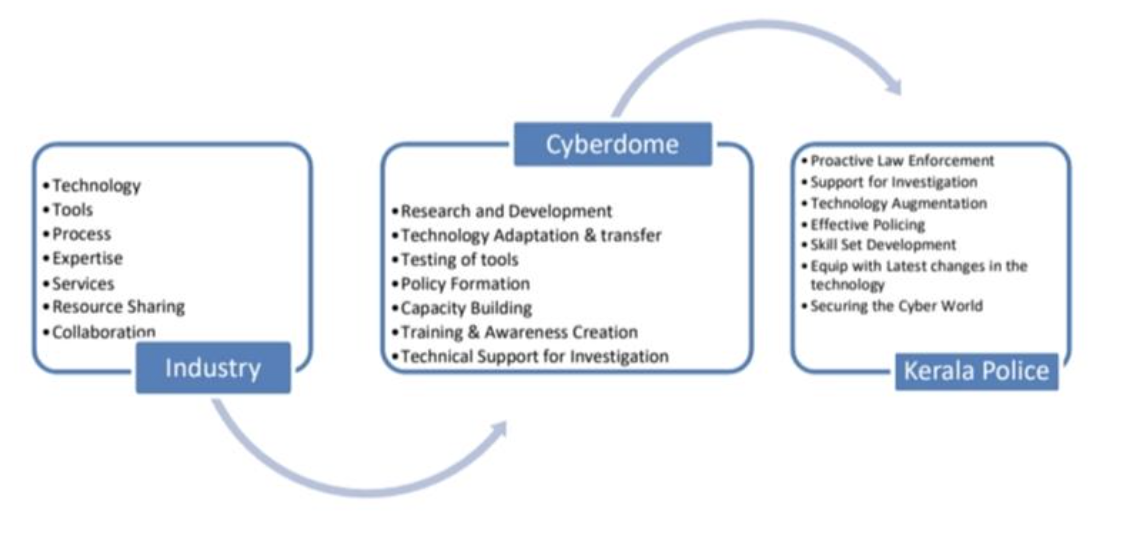
Cyber-dome’s adoption of a public-private partnership (PPP) governance model is its core strength. This structure enables efficient resource mobilization and access to cutting-edge expertise from the private sector without expanding traditional government hierarchies. It aligns with contemporary cybersecurity best practices encouraging collaborative ecosystem building, allowing swift adaptation to rapidly evolving cyber threats.
Collaborative Synergies
The multidimensional collaboration between law enforcement, IT industry giants, cybersecurity firms, academic institutions, and volunteer ethical hackers creates a synergy that strengthens Kerala’s cyber defense architecture. This ecosystem fosters knowledge exchange and innovation, critical for addressing sophisticated cyber challenges such as AI-driven cyberattacks, darknet criminal activities, and financial frauds rooted in mobile technologies.
Technology Integration and Innovation
Cyber-dome demonstrates effective integration of advanced technologies including social media analytics, darknet monitoring, penetration testing, and location tracking with law enforcement processes. These technologies accelerate threat detection and forensic analysis, reducing investigation timelines and improving accuracy. The use of AI and machine learning, although emerging, signals the centre’s forward-looking approach to predictive cyber threat management.
Public Awareness and Capacity Building
A notable aspect of Cyber-dome’s model is its focus on training both police personnel and the public, especially vulnerable groups like children. Initiatives like the “KIDGLOVE” programme and parental control software are vital in enhancing community resilience against cyber exploitation. This preventive approach complements incident response, highlighting an understanding that cybersecurity extends beyond technology to social dimensions.Challenges and Constraints
Despite these advances, Cyber-dome faces significant operational challenges. The shortage of skilled cybersecurity professionals limits its scale and effectiveness. The need for constant technical upgrades, high costs, and rapidly evolving cyber threat landscapes strain its operational capacity. The inherent difficulty in tracing cybercriminals using sophisticated anonymization tools necessitates continuous investment in research and collaborative intelligence sharing.Policy Implications and Future Directions
Cyber-dome’s operation highlights several important policy implications for strengthening Kerala’s cybersecurity ecosystem. Its model shows the need for stronger public-private partnership policies. Collaboration with industry, academia, and ethical hackers is essential for dealing with rapidly evolving cyber threats. The success of Cyber-dome’s vulnerability assessments also suggests the importance of policies that require regular cybersecurity audits and standardized security protocols for all government departments and critical infrastructure. Since cybercrimes often spread across borders, updated legal frameworks are necessary to support faster international cooperation, data sharing, and investigations across jurisdictions. Cyber-dome’s training and awareness initiatives further indicate the need for policies that focus on continuous skill development for police officers and structured digital literacy programs for the public, including children and vulnerable groups. Looking ahead, Cyber-dome should move toward deeper use of AI and predictive analytics to improve threat detection and social media monitoring. It can expand cyber forensic infrastructure, build labs, and develop quicker incident response systems. Strengthening international partnerships, promoting statewide cyber awareness, and creating a hub for new cybersecurity solutions will help Cyber-dome stay ahead of emerging threats such as deepfakes, AI-driven phishing, and identity theft. By expanding its reach to rural communities and improving real-time cyber response mechanisms, Cyber-dome can continue to grow as a leading model for cyber safety and digital protection in the state.References: https://bprd.nic.in/uploads/pdf/Cyber-dome.pdfhttps://keralapolice.gov.in/Jose, T., Vijayalakshmi, Y., & Babu, S. S. (2017). Cyber-crimes in Kerala: A study. Advances in Computational Sciences and Technology, 10(5), 1153-9.