
Citizen-Centric Governance in India: Assessing Public Value Through Service Delivery
Author: K. Bhanu Sri Poorna
I. Introduction:
Traditional public administration primarily emphasized hierarchical authority, rule-based administration with limited opportunities for citizens to participate in decision making. New Public Management introduced market-oriented principles and performance measurement, where citizens were viewed as customers to improve public sector efficiency. However, the limitations of NPM such as efficiency over equity, limited citizen participation, and weak democratic accountability failed to address democratic values and diverse public interests. These limitations contributed to the evolution of citizen-centric governance which places citizens at the centre of policy formulation, implementation and evaluation. Today, governments measure success not only by efficiency but also by the citizens experiences and outcomes. The emphasis must be given to whether service delivery creates value for citizens by improving accessibility, efficiency, transparency and citizen satisfaction. This article explores how recent governance reforms have changed the way citizens access public services and whether those changes have created meaningful public value.
II. Citizen-Centric Governance and Public Value: A Conceptual Foundation
Citizen-centric governance focuses on the needs and experiences of citizens throughout the policy process. It promotes participatory decision-making by encouraging collaboration between governments, people and relevant private stakeholders. This approach encourages governments to deliver services that are accessible, transparent, responsive and inclusive (OECD, 2017). Mark H. Moore's Public Value Theory argues that governments create value when they deliver services that citizens genuinely value (Gavel, 2008).
Using these two perspectives, the article examines whether recent governance reforms have improved citizens' experience of public services.
III. Governance Reforms for Service Delivery in India
The Government of India launched National e-Governance Plan (NeGP) in 2006 to modernize public service delivery. The programme enabled departments to deliver services through integrated digital infrastructure (PIB, 2009). The Digital India programme expanded the scope of digital governance from computerizing government services to transforming the way public services are delivered. It focused on strengthening digital infrastructure, seamless online service delivery, and empowering citizens through interaction with public institutions (ISTI, 2018). India further strengthened governance through the JAM trinity, which supports Direct Benefit Transfer. This initiative improved financial inclusion, mobile connectivity and reduced intermediaries (DBT, n.d.-a).
IV. Assessing Public Value through Service Delivery Outcomes
India’s public service delivery initiatives contribute to the creation of public value. It is essential to examine the extent to which service delivery improvements have enhanced the quality and responsiveness of governance, using dimensions such as accessibility, efficiency, transparency and citizen satisfaction.
1. Accessibility: Accessibility is the citizen’s ability to obtain services regardless of location or administrative barriers.
UMANG brings together government services on a single digital platform for citizens (MeitY, 2026c). UMANG enables access through a unified interface by reducing administrative barriers, improves accessibility, convenience of service delivery.
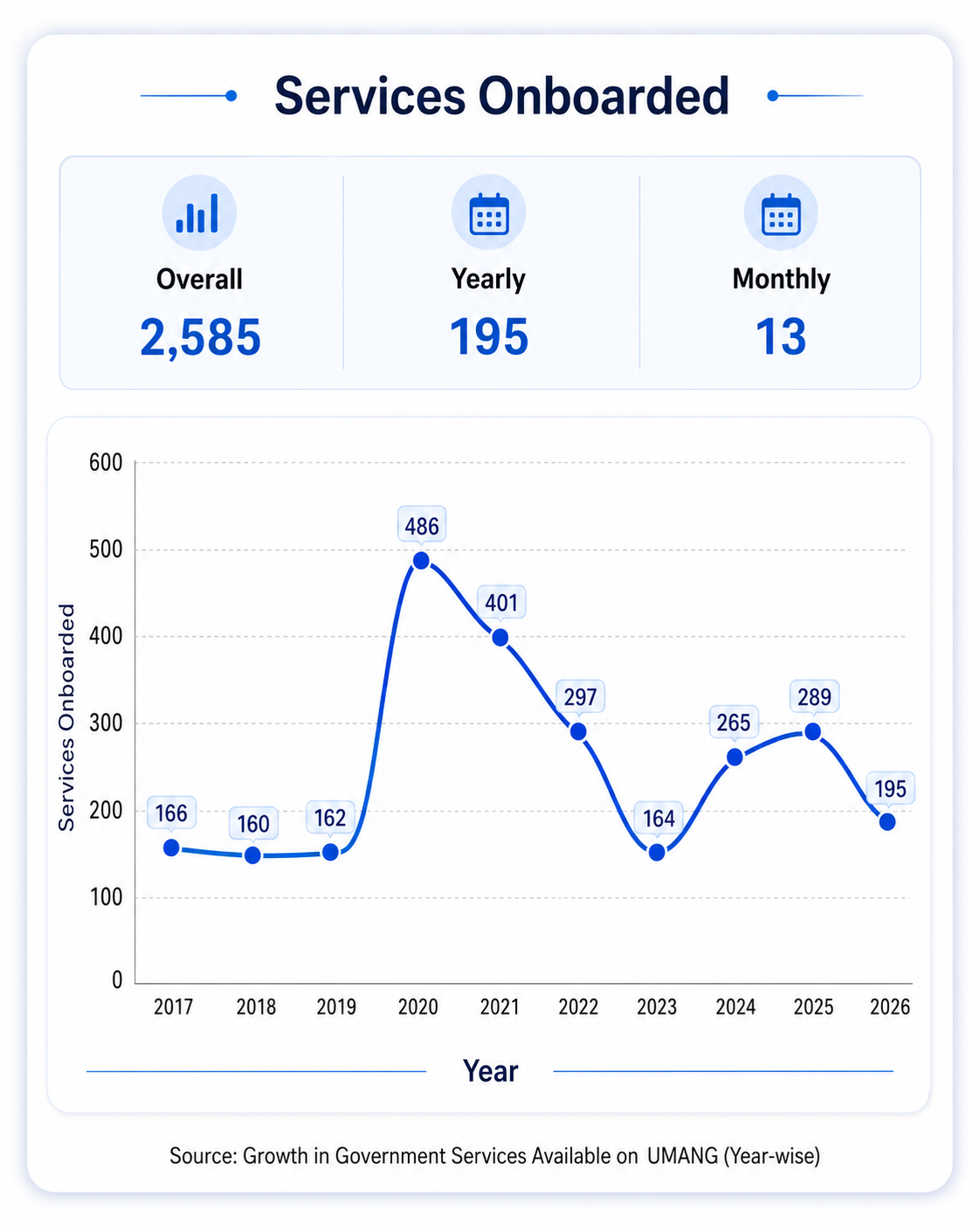
Source: Growth in Government Services Available on UMANG (Year-wise)
The above graph shows that 2,585 government services have been on- boarded in the platform. The largest annual expansion occurred in 2020 with 486 services, which indicates that the platform created accessibility in emergency periods. The steady expansion reflects the government's effort to integrate public services into one platform.
DigiLocker allows citizens to store and share government-issued documents digitally, reducing paperwork during service delivery. It enhanced accessibility through a secure cloud based platform for storage, sharing and verification of documents and certificates (MeitY, 2026a).
DigiLocker now serves over 72 crore registered users and connects thousands of issuing and requesting organizations. Thus, DigiLocker contributes to citizen experience by improving convenience, reducing dependence on physical documentation and repeated visits to government offices, and enhancing citizen’s access to public services (MeitY, 2026b).
The evidence suggests that accessibility has improved not simply because more services are available online, but because citizens can access multiple services through integrated platforms with fewer administrative barriers. This shift reflects a move from fragmented service delivery towards a more citizen-oriented governance model.
2. Efficiency: Efficiency is about ability of public institutions to deliver services faster with fewer procedural delays and minimum cost, maximizing value and citizen satisfaction.
Direct Benefit Transfer (DBT) was introduced to transfer welfare benefits directly into beneficiaries' bank accounts by eliminating middlemen, corruption, delays in social welfare delivery. The JAM trinity enables DBT by linking bank accounts, Aadhaar and mobile numbers. The integration of 318 welfare schemes, participation of 56 ministries into a common DBT platform indicates that multiple programmes share a unified digital delivery system. The platform processed 163 crore transactions during the financial year and transferred more than ₹52.58 lakh crore, indicating the capacity of the DBT ecosystem, and became the principle mechanism for delivering welfare benefits directly to beneficiaries through digital channels (DBT, n.d.-b).
Ayushman Bharat Digital Mission connects health records digitally, allowing hospitals and patients to access information more efficiently. Nearly 95 crore citizens have been assigned a unique digital health identity. More than 106 crore health records have been digitally linked to ABHA accounts. Healthcare providers retrieve patient records digitally instead of recreating medical histories. The platform also connects a large network of healthcare facilities and over one million digitally registered healthcare professionals which indicate more reliable and efficient delivery of healthcare services (NHA, n.d.).
DBT and ABDM shows how digital governance improves efficiency in different sectors. While DBT reduces delays in welfare delivery, ABDM improves continuity of healthcare by enabling secure digital records. Together, they show how digital platforms can reduce administrative effort while improving service quality.
3. Transparency: Transparency allows citizens to monitor how governments deliver services and spend public funds.
PFMS (Public Financial Management System) tracks government fund flows and digital payments across public programmes (Controller General of Accounts, 2024a).
PFMS facilitates digital payments, fund monitoring, accounting and financial reporting. For payment to any bank account holders, PFMS will show the status of transaction wise payments (Controller General of Accounts, 2024b). These features make financial transactions easier to track and verify.
e-District delivers high-volume public services through a single digital portal. It acts as a single-window portal allowing citizens to apply for essential certificates (like income, caste, and birth certificates), access land records, and track application statuses online. The programme has initiated deployment of e-District Managers in 34 States and Union Territories, indicating widespread institutional adoption (MeitY, 2018).
These initiatives improve transparency at different stages of governance. PFMS increases financial visibility, whereas e-District allows citizens to monitor service requests directly. Together, they reduce information gaps between government agencies and citizens.
4. Citizen Satisfaction:
The Centralized Public Grievance Redress and Monitoring System (CPGRAMS) allows citizens to submit and track grievances through a single online platform. The CPGRAMS dashboard shows effective grievance redressal across several major citizen-facing departments, such as Consumer Affairs (98.90%), Agriculture and Farmers Welfare (97.23%), Health and Family Welfare (96.95%), recorded high grievance disposal rates. By enabling citizens to register grievances, track their status, and receive timely resolutions, CPGRAMS strengthens citizen satisfaction, reinforces trust in public institutions, and contributes to the creation of governance performance through more responsive governance (DARPG, 2026b). Source: Citizen Satisfaction and Resolution Status under CPGRAMS
Citizen feedback also helps evaluate how effectively departments resolve grievances. During the period from 1st May, 2026 to 31st May, 2026 a total of 78,830 feedbacks were received out of which 32,283 were received from States/UTs through the Call Centre. A total of 13,799 grievances were marked as resolved, reflecting a resolution rate of 43%. Among the resolved cases, over 65% of citizens expressed satisfaction with the solution provided (DARPG, 2026a).
These findings suggest that while CPGRAMS has strengthened institutional responsiveness, improving the quality of grievance resolution remains important for enhancing citizen trust and satisfaction.
V. Institutional and Implementation Challenges Affecting Citizen-Centric Governance
Although India's digital governance reforms have significantly improved accessibility, efficiency, transparency and citizen satisfaction, several institutional and implementation challenges continue to affect the creation of public value.
The digital divide continues to limit equal access to online public services. Rural tele-density stood at 48.31 internet subscribers per 100 population against 126.80 in urban areas as of early 2026 (TRAI, 2026). The Pradhan Mantri Gramin Digital Saksharta Abhiyan (PMGDISHA) trained 6.39 crore rural citizens against its 6-crore target by 2024 (MeitY, 2024). Yet the persistence of the urban-rural connectivity gap two years later suggests that digital literacy gains have not been matched.
Interoperability and data integration across government departments are still evolving, resulting in fragmented service delivery and duplication of administrative processes.
Increasing reliance on digital platforms raises concerns regarding data privacy, cybersecurity and the protection of citizens’ personal information, making robust governance frameworks essential.
Variations in digital infrastructure, institutional capacity and administrative capabilities across states lead to uneven implementation and differences in service quality.
Grievance redressal mechanisms such as CPGRAMS have improved institutional responsiveness. However, grievance disposal does not always translate into satisfactory resolution, indicating the need to strengthen the quality of service-delivery alongside administrative efficiency.
Addressing these institutional challenges is essential for ensuring that digital governance reforms create equitable and sustainable public value.
VI. Policy Measures to Strengthen Public Value Creation through Service Delivery Reforms
To strengthen public value creation through citizen-centric governance, policy efforts should focus on improving both institutional capacity and citizens' service experience.
BharatNet should be expanded alongside renewed digital literacy initiatives to narrow the rural–urban access gap.
Dashboards for DBT, ABDM, and CPGRAMS currently report volumes, savings, and disposal times comprehensively; these should be paired with periodic, independently collected outcome indicators- nutritional status for food subsidy schemes, health-seeking behaviour for ABDM, repeat-grievance rates by scheme rather than by ministry so administrators can distinguish process efficiency from citizen-experienced value.
Service delivery performance should be evaluated using citizen-centric indicators such as accessibility, transparency, grievance resolution quality and citizen satisfaction, rather than relying solely on administrative output measures.
Finally, state-level implementation gaps warrant a structured capacity-building mechanism, such as tying central scheme funding to measurable interoperability and service-quality benchmarks, to reduce the variation in digital governance readiness across states.
Such measures shift the policy focus from expanding platform coverage to closing the specific institutional gaps’ access, interoperability, data governance and outcome measurement that currently limit how much public value India's service delivery reforms actually generate.
Conclusion
India's digital governance initiatives have changed how citizens interact with public institutions by making many services faster, more accessible and easier to monitor. The examples discussed in this article show that digital platforms can improve governance when they reduce administrative barriers and respond to citizens' needs. However, challenges relating to digital inclusion, interoperability, data protection and implementation capacity continue to affect outcomes across states. Addressing these gaps will determine whether future governance reforms create lasting value for citizens rather than simply expanding digital platforms.
References
Controller General of Accounts. (2024a). PFMS. Controller General of Accounts, Department of Expenditure, Ministry of Finance, Government of India. here
Controller General of Accounts. (2024b). PFMS. Controller General of Accounts, Department of Expenditure, Ministry of Finance, Government of India. here
DARPG. (2026a). CPGRAMS Monthly Report – States/UTs: May 2026 (Report No. 462) (Issue 46).
DARPG. (2026b). Dashboard. Department of Administrative Reforms and Public Grievances, Ministry of Personnel, Public Grievances and Pensions, Government of India. here
DBT. (n.d.-a). About Us | (DBT) Direct Benefit Transfer. Direct Benefit Transfer (DBT) Bharat. Retrieved July 26, 2026, from here
DBT. (n.d.-b). Homepage | (DBT) Direct Benefit Transfer. Cabinet Secretariat, Government of India. Retrieved July 26, 2026, from here
Gavel, D. (2008). Creating public value | Harvard Kennedy School. Harvard Kennedy School. here
ISTI. (2018). Digital India (DI). India Science, Technology & Innovation (ISTI) Portal. here
MeitY. (2018). Digital India.
MeitY. (2026a). DigiLocker | Access, Share & Verify Digital Documents. GOI. here
MeitY. (2026b). Statistics. GOI. here
MeitY. (2026c). UMANG - One App, Many Government Services. Government of India. here
NHA. (n.d.). NHA | Official website Ayushman Bharat Digital Mission. National Health Authority, Ministry of Health and Family Welfare, Government of India. Retrieved July 26, 2026, from here
OECD. (2017). Recommendation of the Council on. here
PIB. (2009). English Releases. Press Information Bureau (PIB). here
Ministry of Electronics and Information Technology. (2025, November 13). Digital Personal Data Protection Rules, 2025 notified. Press Information Bureau, Government of India. here
Press Information Bureau. (2024, December 4). 6.39 crore individuals trained under Pradhan Mantri Gramin Digital Saksharta Abhiyan (PMGDISHA) exceeding the target of 6 crore. Government of India. here
Telecom Regulatory Authority of India. (2026, June 22). The Indian Telecom Services Performance Indicators, January–March 2026. here