
India’s Digital Public Infrastructure Diplomacy: Reimagining Development Cooperation in the Global South
Introduction
Development cooperation has for long been closely linked to financial support, infrastructure projects and technical assistance. Countries seeking to broaden their international influence often did so through loans, grants, and massive development programs. However, the rapid digitalisation of both economies and public services has started to transform the nature of development partnerships. The exchange of technology, institutional know-how and solutions for digital governance is today increasingly becoming a new area for cooperation, especially among developing countries.
The rise of India as a leading advocate for Digital Public Infrastructure (DPI) is indicative of this change. India has built a digital ecosystem through such initiatives as Aadhaar, Unified Payments Interface (UPI), DigiLocker and CoWIN that has enabled financial inclusion on a massive scale and access to public services by millions of citizens (MeitY, 2023). After proving the utility of these platforms at home, India is now looking to share its experience with countries in Africa, Asia, and Latin America through partnerships focused on capacity-building, technical assistance, and digital cooperation (MEA, 2024).
This evolution mirrors a larger change in how India now views development diplomacy. Instead of relying solely on traditional forms of aid, India is increasingly branding itself as a source of scalable development solutions for the needs of the Global South. With digital public infrastructure capturing the interest of policymakers globally, Indian initiatives pose a provocative question: can the export of digital governance models emerge as one of the most powerful tools of development cooperation of the twenty-first century? This article analyses how the DPI initiatives India are pursuing in development partnerships, South-South cooperation, and its own place in the re-configuring global development system.
India’s DPI Model: From Domestic Innovation to Global Template:
Digital public infrastructure (DPI) refers to the essential digital systems which governments, businesses, and ordinary citizens rely on to interact with one another efficiently and securely (UNDP, 2024). DPI is not like traditional digital services offered by commercial companies; it is a public good and provides interoperable platforms for core activities like identity, payments, and data sharing. India has become a global leader in this space in the last ten years by building what is popularly known as the India Stack, which is a series of digital platforms that enable access to public services and financial inclusion (MeitY, 2023).
Aadhaar, the world’s largest biometric identification program, which gives a verifiable digital identity to over a billion citizens, lies at the core of this ecosystem. Complementing this is the Unified Payments Interface (UPI), a real-time payment system that has revolutionised digital transactions by facilitating instant and low-cost transfers among individuals, businesses and across the ecosystem. Other platforms like DigiLocker and CoWIN have since shown how digital infrastructure can be leveraged in anything from document management to public health delivery (NPCI, 2025).
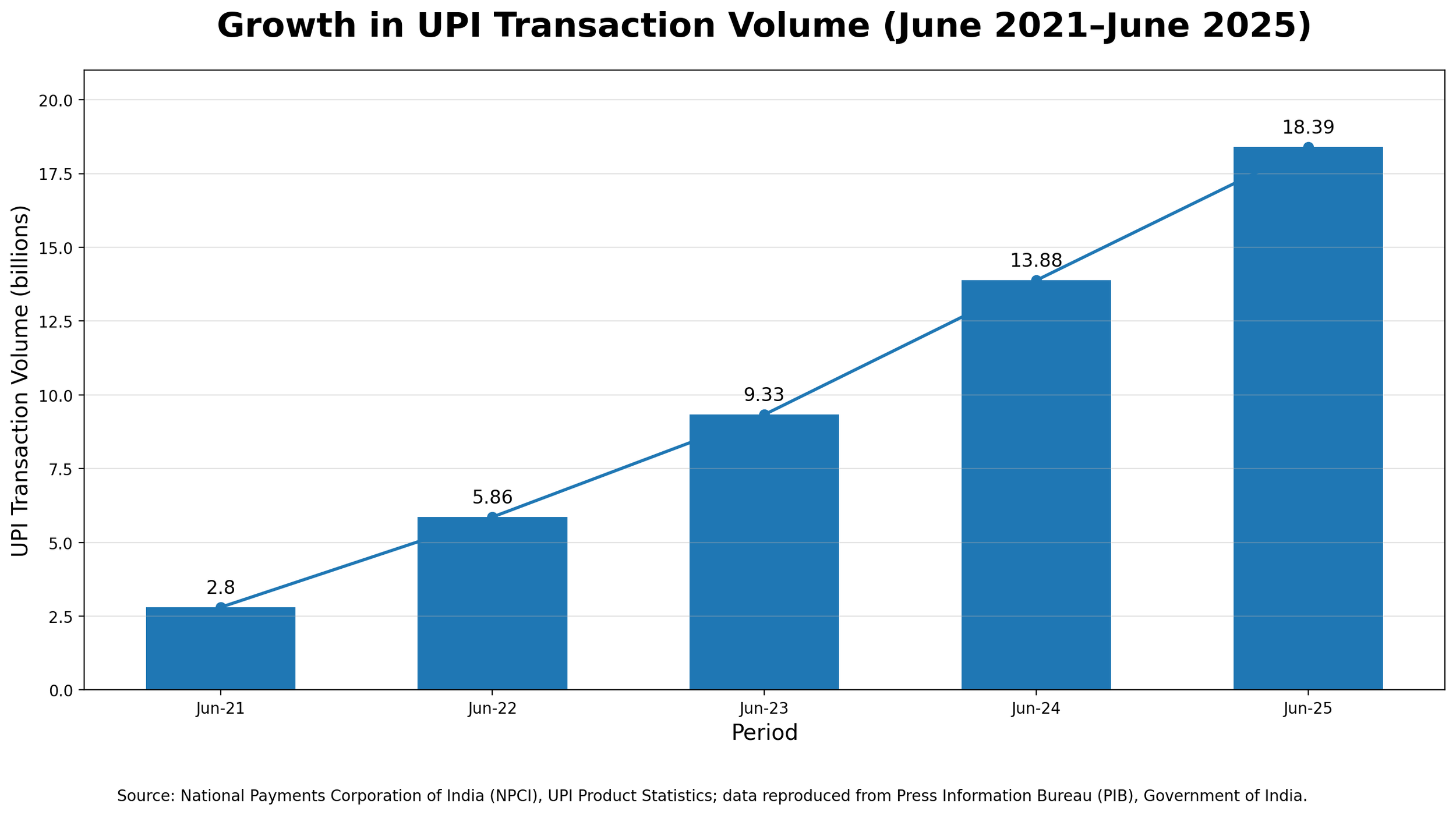
Figure 1 shows that the rapid increase in UPI transactions demonstrates the size and sophistication of India's digital payments system, which is a crucial pillar of India's Digital Public Infrastructure (DPI) model.
The importance of these efforts goes far beyond innovation in technology. With lowered transaction costs, simplified welfare delivery and widened access to financial services, India’s DPI model has tackled issues that affect many developing countries. As under-resourced governments of the Global South look for affordable means to enhance governance and speed up digital inclusion, India’s trajectory provides a counterpoint to costly proprietary systems too often created in the Global North (World Bank, 2024).
As a result, the digital infrastructure in India, initially a tool for domestic governance, has morphed into a model that is drawing global attention. This emerging interest has created the basis for a new mode of development cooperation, in which technology, institution-building and capacity-building complement traditional flows of aid.
DPI as an Instrument of Development Diplomacy
The rising global attention to India's digital infrastructure is indicative of wider changes in the 'development cooperation' landscape. Development cooperation partnerships have traditionally been focused on financial support, infrastructure investments, and technical assistance. Although these continue to be significant, the digital age paves the way for countries to exchange governance solutions, technological expertise, and institutional know-how. India has steadily adopted this approach that sees Digital Public Infrastructure as not just a domestic success story but as a pillar of its development diplomacy.
During its long history with the Non- Aligned Movement (NAM), India focused on building capacities and sharing knowledge rather than providing large amounts of aid, in its development partnerships. Schemes like the Indian Technical and Economic Cooperation (ITEC) programme have trained thousands of officials, professionals and policymakers from developing countries, generating institutional linkages and human capital development in the Global South. The promotion of DPI represents an evolution of this tradition. Digital cooperation has become a new frontier of development partnerships, enabling partner countries to learn from India's experience in digital governance, financial inclusion, and public service delivery (MEA, 2024).
The increasing importance of DPI in India's external outreach was especially evident during its G20 Presidency in 2023. India promoted the Digital Public Infrastructure as an instrument of inclusive growth and sustainable development while making the case that open and interoperable digital ecosystems could contribute to bridging development gaps in the Global South. In showcasing its digital transformation as one that could be replicated, India was attempting to make technology-led development the locus of the global policy conversation. This endeavour led to activities that encouraged knowledge sharing and south-south cooperation in DPI (G20 India, 2023).
Outside multilateral forums, India has sought to build bilateral digital cooperation. The global rollout of the Unified Payments Interface (UPI) has also been touted as a key example of this approach. Bilateral agreements with Singapore, the United Arab Emirates, Mauritius, Sri Lanka and France are also expanding the reach of India's payments system and enabling cross-border digital transactions. At the same time, India has also signed agreements and Memoranda of Understanding (MoUs) on digital identity systems, e-governance platforms and digital capacity-building with a number of nations in Africa, Asia, and Latin America. Initiatives of this kind show that digital infrastructure is an increasingly important component of contemporary diplomacy (NPCI, 2025).
The attractiveness of the Indian model lies, in part, in its relevance to the situations of many developing countries that were faced with much of what India faced when it embarked on its own digital journey. Financial inclusion is minimal, public services are delivered poorly and bureaucracies that span sectors are weak in many countries of the Global South. India's example shows how digital tools can be used at scale without breaking the bank. As a result, the exchange of technical expertise and knowledge of institutions has become an integral part of South-South collaboration.
At a broader level, the diplomacy of DPI also has strategic implications for India. Through building long-term institutional ties with partner nations by helping them enhance their digital governance capabilities, India is able to build long-term institutional ties reinforcing its image as a trustworthy development partner. Rather than be based on traditional definitions of soft power, which are largely dependent upon culture, values, or ideology, India’s digital diplomacy is linked to tangible developmental outcomes. The capacity to offer practical responses to governance and development problems lends India clout and moral authority in the Global South. With global competition over technology, digital standards, and models of development heating up, Digital Public Infrastructure (DPI) is becoming a channel through which India can contribute to global development while furthering its diplomatic and strategic interests.
India’s Global DPI Footprint: From Vision to Implementation:
India's promotion of the Digital Public Infrastructure model has increasingly materialised into international partnerships, signalling a move away from conceptual deliberations to practical execution. Instead of selling a single technology product, India is promoting an ecosystem of Indian digital solutions enabled by technical expertise, institutional cooperation, and capacity -building. This allows partner nations to tailor aspects of India’s digital architecture to their own development priorities while fostering enduring institutional collaboration.
Table 1. Selected Global Digital Public Infrastructure (DPI) Partnerships of India
| Country | Initiative | Development Significance |
|---|---|---|
| Singapore | UPI–PayNow linkage | Enables instant cross-border remittances and promotes financial connectivity. |
| United Arab Emirates | UPI acceptance | Facilitates digital payments for trade, tourism, and the Indian diaspora. |
| France | UPI acceptance | Marks UPI’s expansion into Europe and promotes international interoperability. |
| Mauritius | UPI acceptance | Strengthens digital financial inclusion and bilateral digital cooperation. |
| Sri Lanka | UPI acceptance | Enhances regional payment connectivity and digital economic integration. |
| Nepal | UPI acceptance | Supports cross-border payment interoperability and regional integration. |
Source: National Payments Corporation of India (NPCI)
The scope of India’s digital engagement goes beyond the realm of payments to that of overall governance cooperation. India has also signed bilateral arrangements and MoUs with a number of countries for cooperation in the fields of digital identity systems, digital governance, cybersecurity and delivery of public services. Capacity building, technical training and institutional exchanges have increasingly become the focus of such partnerships, allowing governments to build contextually relevant digital ecosystems rather than sourcing technological solutions directly from abroad. This focus on the sharing of knowledge is said to be at the core of India’s model of South-South cooperation, which emphasises development partnerships based on mutual learning and sharing experiences outside of donor-recipient relations (MEA, 2024).
Multilateral forums have added impetus to India’s pursuit of placing DPI at the forefront of the global development agenda. During its 2023 G20 Presidency, India promoted DPI as a driver of inclusive growth and bolstered efforts like the Global Digital Public Infrastructure Repository to allow for the sharing of best practices between nations. By promoting the principles of open, interoperable, and inclusive digital systems, India has sought to promote global collaborative solutions for digital transformation that address common developmental concerns in countries across the Global South (G20, 2023).
These measures demonstrate that India’s digital diplomacy goes beyond mere technology export. Rather than technological exports, what is being exported are governance models, institutional know-how and policy innovation. With a growing number of countries looking at digital solutions to advance financial inclusion and delivery of public services, India’s increasing number of DPI partnerships underscores the importance of digital collaboration in the development diplomacy of today.
Opportunities and Challenges for India’s DPI Diplomacy:
India’s growing digital ties are a reminder of how Digital Public Infrastructure (DPI) can reshape development cooperation. India’s provision of interoperable, affordable, and scalable digital solutions to the Global South is an alternative narrative for digital transformation — one that centres on inclusivity, public ownership, and institutional capacity-building. Instead of conventional development aid that mainly concentrates on monetary support or physical infrastructure, DPI collaboration allows partner nations to bolster governance frameworks via technology transfer, policy cooperation, and technical know-how (World Bank, 2024).
One of the biggest prospects with India-led DPI diplomacy is that it can enable faster financial inclusion. Governments can use secure digital identity systems and interoperable payment platforms to bring more people into the banking system, enable the direct delivery of benefits, reduce transaction costs, and make welfare delivery more efficient. Besides, digital governance platforms could be used to increase administrative transparency, curtail leakage in public expenditure and raise the reach of basic public services. For numerous nations in the Global South confronting comparable developmental predicaments, India has shown them a workable model of how digital technologies may be harnessed to foster inclusive growth (UNDP, 2024).
Nevertheless, the global replication of India’s DPI model comes with significant challenges. Reliable internet infrastructure, high levels of digital literacy and strong institutional capacity are needed for a digital transformation, and these vary considerably across the developing world. In the absence of complementary investments in the areas of connectivity, education and administrative functioning, the advantages of Digital Public Infrastructure may continue to be out of reach for large segments of the population, thereby exacerbating, rather than ameliorating, existing inequalities.
Data governance and security are also major concerns. With governments adopting digital identity schemes and digital payment systems at an ever-faster pace, securing personal data and critical digital infrastructure is becoming a top priority. Partner countries will need to develop full legal and regulatory frameworks that protect privacy and maintain public trust in digital systems. Also, India’s DPI model should not be considered as a template that can be universally applied. Democratic institutions, laws and governance capacities vary significantly from country to country, and therefore must be tailored locally for them to be effective (World Bank, 2024).
In the end, the success of the Digital Public Infrastructure diplomacy, being pursued by India, will depend not just on the export of technological solutions, but on the sustainability of the partnerships it builds. Sustained efforts in capacity-building, institutional engagement, and inclusive digital governance will determine whether India’s approach to the DPI becomes an enduring pillar of development cooperation or a context-specific policy success adaptable only by arcane context-specific conditions.
Conclusion
The Indian model of Digital Public Infrastructure (DPI) represents a fundamental pivot in development cooperation, from the angle of traditional assistance to technology- based partnerships centred on sharing knowledge, building capacity, and the collaboration of institutions. With products like UPI, digital governance partnerships and south-south cooperation India is getting positioned more and more as a solution provider for scalable development in the Global South.
References:
1) Government of India. (2023). G20 New Delhi leaders' declaration. Ministry of External Affairs.
2) Global Digital Public Infrastructure Repository. Ministry of Electronics and Information Technology, Government of India. (2024)
3) Ministry of Electronics and Information Technology. (n.d.). India Stack. Government of India.
4) Ministry of External Affairs. (n.d.). Indian Technical and Economic Cooperation (ITEC) Programme. Government of India.
5) UPI product statistics.
6) Press Information Bureau. (2025). India's Digital Public Infrastructure. Government of India.
7) Annual report 2023–24. Reserve Bank of India. (2024)
8) United Nations Development Programme. (2023). Digital Public Infrastructure: Accelerating the Sustainable Development Goals.
9) World Bank. (2023). Digital public infrastructure: Transforming service delivery across sectors. In Digital Progress and Trends Report 2023.
10) World Bank. (2025). Digital Public Infrastructure and Development: A World Bank Group Approach.