
Beyond the Exchange Rate: Understanding Rupee Depreciation and India's External Sector Vulnerabilities
1. Introduction:
Exchange rates act as a very important gauge of external strength in a country. These can affect various areas including trade competitiveness, foreign investment, and other macroeconomic variables. In recent years, there has been significant weakening of the Indian Rupee against the US Dollar. The exchange rate breached the value of ₹85 per dollar in 2025 and has hit all-time lows due to the increasing FPI outflow from the country in uncertain times. (Reserve Bank of India, 2025) It is imperative to discuss certain aspects of the weakening of the Indian Rupee against the US Dollar.
The current depreciation of the rupee can be attributed to an array of global factors, such as the strength of the US dollar, growing interest rates around the world, geopolitical issues, and volatility in capital flows. (International Monetary Fund [IMF], 2025) Moreover, domestic issues, like the country's reliance on importing crude oil, trade imbalance, and susceptibility to portfolio capital movements, add to the exchange rate risks facing the country. The effects of depreciation include increased import prices and inflation, higher external debt payments, and negative investor sentiment, whereas depreciation stimulates the economy's exports and attracts investments to export-dependent industries, such as IT.
This paper seeks to explore the main reasons for the depreciation of the rupee, identify its implications, and analyse the foreign exchange interventions made by the Reserve Bank of India. Specifically, it will be argued that although global factors have sped up rupee's depreciation, underlying vulnerabilities of India's external sector continue to drive the trend of exchange rate pressure on the country.
2. Recent Trend in the Rupee-Dollar Exchange Rate:
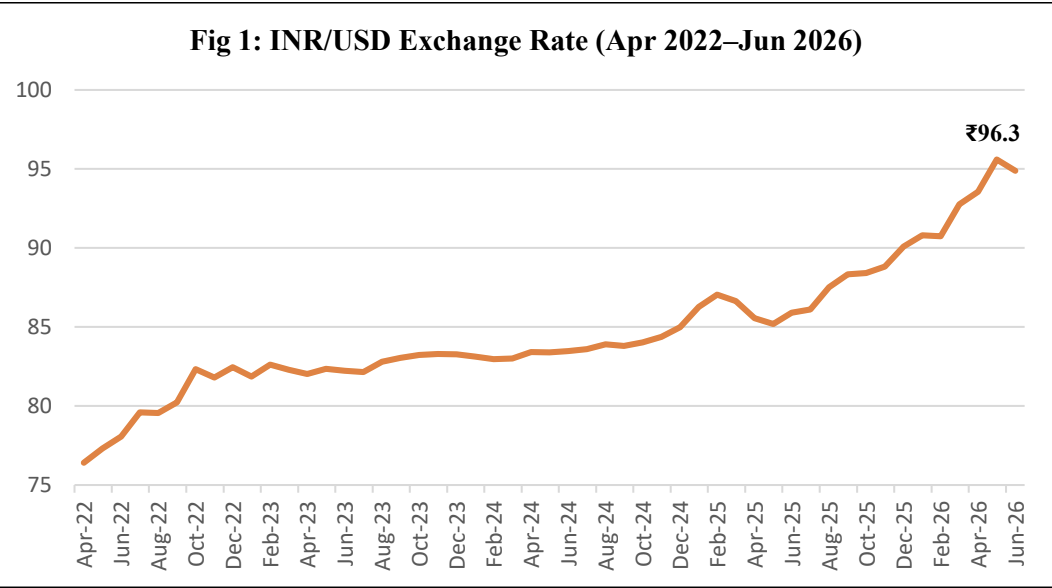
Source: Data compiled from RBI’s website
It can be seen from the chart that the Indian Rupee has weakened constantly against the US Dollar in the past four years. Having softened a bit in late 2022, the exchange rate stabilized
at levels around ₹82–84 per dollar during 2023 and in early 2024. (Reserve Bank of India, 2025) But strengthening depreciation pressures in the second half of 2024 saw the rupee break through the ₹85 per dollar mark, and later the ₹90 per dollar line driven by a surge in capital outflows and global economic uncertainty.
Recently, the depreciation happened against the backdrop of a rise in the US dollar demand, high interest rates in developed countries, and geopolitical tensions. With the investors moving their capital into dollar-denominated assets and growing interest in these investments, the pressure on emerging market currencies, including the Indian one, increased. In addition, high oil prices made the import bills higher and increased demand for foreign currency.
Exchange rate fluctuations are characteristic of the regime of market-based currencies, yet the persistent depreciation proves that it is caused not only by some global events happening at the moment. On the contrary, there are certain structural risks associated with the open nature of the country's economy.
3. Causes of Rupee Depreciation:
3.1 Global Factors:
Depreciation of Indian currency has also been affected considerably by the economic situation prevailing internationally and the monetary policies adopted by the United States and other nations. In the aftermath of rising inflation since the time of the pandemic, the Fed decided to embark on an aggressive monetary tightening program, with interest rates being pushed to their highest level in several years. (IMF, 2025) Interest rate hikes in the US made investments denominated in dollars more attractive to investors globally, compelling investors to shift funds from emerging economies into the US, resulting in substantial FPI outflows from emerging markets like India, thus driving up the demand for the US currency and thereby devaluing the rupee. (Ministry of Finance, 2025)
Alongside this, appreciation of the US dollar against other world currencies has also played its part in rupee devaluation. The economic turmoil experienced at the time made US Treasury bonds more attractive for global investors. In fact, US dollars have continued to remain the preferred option for the world's major currencies when investing in times of economic instability. Geopolitical tensions, including those like the ongoing West Asian conflict, and the blockage of international maritime trade routes, have raised the risks of aversion among international investors, leading them to allocate their funds to safe haven assets like the US Dollar.
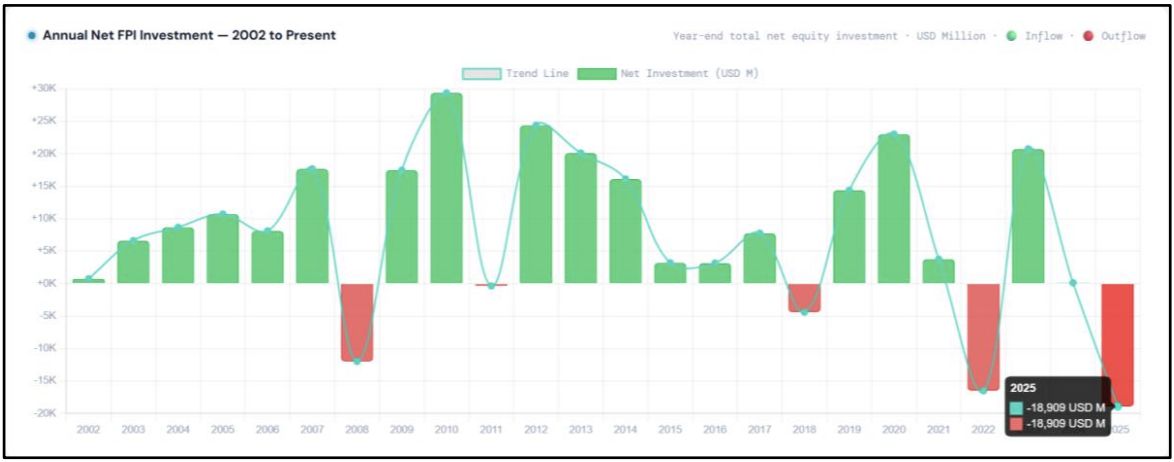
Source: FPIdata.in; compiled from National Securities Depository Limited (NSDL) data
Fig 2: Annual Net Foreign Portfolio Investment (FPI) Flows in India (2021–2025)
As can be seen in the above graph, in 2021, India saw a positive net inflow of FPIs, but a year later, in 2022, India faced large net outflows from FPIs; in 2025 too, net outflows occurred from FPIs into India. (FPIdata.in, 2025) All these have been attributed to the change in investor sentiment in the rest of the world, monetary policy actions in the United States, and an appreciation for dollar investments. As the depreciation pressures on the rupee started to become more intense, outflow from FPIs resurged once again in 2025.
3.2 Domestic Factors:
The reliance of the nation on foreign crude oil continues to be among the most important internal variables that make the currency rate vulnerable. India imports more than 85% of its requirements for crude oil. (Ministry of Finance, 2025) As such, any change in prices within the global market affects the nation negatively because higher crude prices mean high costs for importing crude oil. In turn, there is a need for more USDs to buy the crude oil, and hence, depreciation of the Indian rupee and an increase in the trade deficit. (Reserve Bank of India, 2024)
Fig 3: Brent Crude Oil Prices (2022–2026)
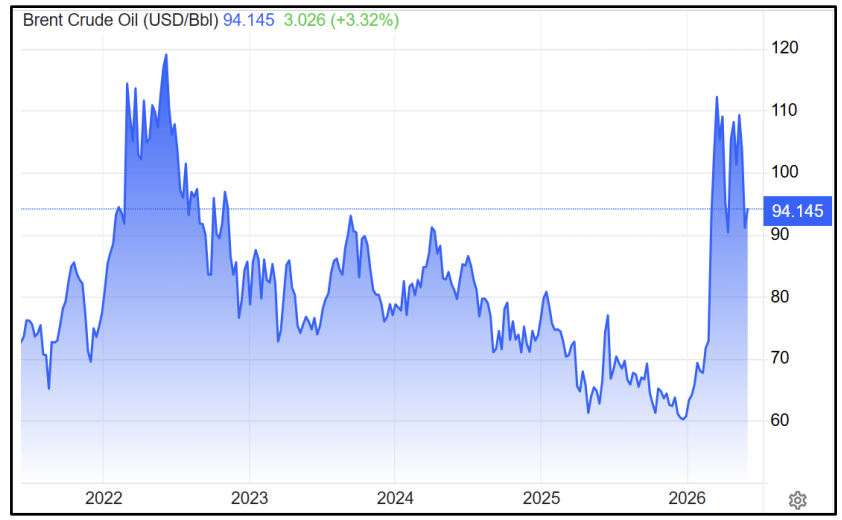
Source: Trading Economics
This figure shows the Brent crude oil price movements for 2022 to 2026. India's import burden increased with rising oil prices and the demand for foreign exchange soared. This was because the country was heavily reliant on imported crude oil and that made India more vulnerable to international energy price fluctuations.
Traditionally, India has been experiencing a merchandise trade deficit because of its heavy reliance on foreign crude oil and electronics. While the country's service exports may balance things out, its rate of importing exceeds the value of exports. As a result, India's need for foreign currencies leads to the devaluation of its national currency – the rupee.
Consistently negative current account balances have resulted in a greater need for foreign capital flows to meet the country’s foreign exchange needs. Although such flows may be helpful in alleviating exchange rate problems for a period of time, they leave the country
vulnerable to abrupt changes in investors’ mood. (Patnaik & Shah, 2010) When global conditions are uncertain, the resulting capital flight becomes rapidly manifest through depreciating currency rates.
4. Economic Impact of Rupee Depreciation:
4.1 Inflation and Import Costs:
One immediate effect of the rupee’s depreciation is a rise in the cost of imports. India is a major importer of crude oil, natural gas, electronics and industrial raw materials, and the weakened rupee leads to a rise in the cost of these commodities at home. This leads to higher production and transportation costs across the economy as a result of this so-called imported inflation phenomenon. (Reserve Bank of India, 2024) Surge in fuel prices, in particular, has a ripple effect on prices of goods and services which erodes the purchasing power of households and makes herding inflation less easy. As a result, continued depreciation may hurt the overall macroeconomic stability and put further strain on the monetary authorities.
4.2 Trade Balance and Export Competitiveness:
The implications of rupee depreciation on India’s trade balance are mixed. India rupee depreciation has two sides to its effect on India’s trade balance. On one side, a declining rupee makes Indian exports more price competitive in the global market as they become relatively cheaper for foreign buyers. (Ministry of Finance, 2025) Export-oriented units like textiles, pharma and engineering goods could see a surge in demand. However, on the upside for the trade balance, the terms-of-trade gain for the real depreciation is eventually partially offset by some increases in the price of exports (mainly crude oil and capital goods). An export growth that outpaces the increased import burden may be needed for the overall trade balance effect to be significantly positive, simply because India is so heavily reliant on imported goods.
4.3 Impact on the IT and Services Sector:
The rupee's slide is a boon for the information technology and business process outsourcing sectors among others. As a majority of their revenues are realised in US dollars and the expenses are in rupees, a weaker rupee means higher profit margins when the foreign income is converted into local currency. (Reserve Bank of India, 2024) Therefore, major Indian IT firms generally saw an increase in revenues during sustained depreciation period. But too
much exchange-rate volatility may also cause uncertainty in business planning and investment, and may limit some of these benefits, the think tank warned.
4.4 Capital Flows and External Debt:
Depreciation may play a role in investor sentiment and terms of external finance. A sustained decline in the rupee could deter foreign investment by enhancing exchange rate risk and raising doubts about macroeconomic stability. Also, when depreciation raises the price of servicing external debt in foreign currency, borrowers need more rupees to pay their debts. (IMF, 2025) This could put additional strain on the finances of both companies and governments, particularly when the cost of borrowing globally is already high.
5. RBI Response, Structural Vulnerabilities and Policy Recommendations:
The Reserve Bank of India (RBI) has been very active in stabilizing exchange rates with the help of monetary policies as well as through actions taken in the foreign exchange market. In times of increased depreciation risk, the RBI sells off US dollars held in the form of foreign exchange reserves to stabilize any extreme volatility. However, no matter what actions are taken in the short run, depreciation caused by economic factors cannot be offset.
Furthermore, the most recent depreciation phase has pointed out many structural weaknesses associated with India's external balance situation. The fact is that India continues to rely heavily on foreign crude oil, runs consistent trade deficits, and relies on risky portfolio investments for its external funding needs. Therefore, the external value of the Indian currency is highly sensitive to global commodity prices, global financial markets, and monetary trends.
In order to address the problem, India will need a more sustained policy framework. Export promotion through increased participation in value-added manufacturing exports will make India less dependent on foreign goods, improving its external situation. Using more renewable energy and fewer imported fuels would lessen vulnerability to changes in global commodity pricing. Lastly, attracting sustainable foreign direct investment would help to strengthen the country's external position.
Conclusion:
The Indian rupee's fall against the dollar is a consequence of both international economic phenomena and domestic structural problems. Evolving situations of monetary policy and a stronger dollar, along with geopolitical tensions and capital outflows have increased pressures on exchange-rate pressures. India's reliance on imported energy, a persistent trade deficits, and unpredictable portfolio flows only work to further exacerbate these pressures. Apart from the positive effects rupee depreciation has on trade (due to the greater competitiveness of developing markets), the negative effects of depreciation have been pervasive. These have been manifested through increased burden of external debt, costs of rising imports, and inflation. While the RBI's market interventions have been successful in limiting periods of acute disruption, the long-term stability of currency markets will be reliant on improvements to the economy's fundamentals. Among the most important would be the reduced reliance on imports and the increased stability and improvement of the economy's externals in the long term.
References:
1) Reserve Bank of India. (2024). Annual report 2023–24. Reserve Bank of India. https://www.rbi.org.in
2) Reserve Bank of India. (2025). Reference rate archive. Reserve Bank of India. https://www.rbi.org.in/scripts/referenceratearchive.aspx
3) Reserve Bank of India. (2025). Database on Indian economy (DBIE). Reserve Bank of India. https://data.rbi.org.in
4) FPIdata.in. (2025). Annual net FPI investment (2002–present). https://fpidata.in/annual.html 5) International Monetary Fund. (2025). India: 2025 Article IV consultation—Staff report. International Monetary Fund. https://www.imf.org
6) Ministry of Finance, Government of India. (2025). Economic survey 2024–25. Government of India. https://www.indiabudget.gov.in/economicsurvey
7) Trading Economics. (2026). Brent crude oil. https://tradingeconomics.com/commodity/brent crude-oil
8) Patnaik, I., & Shah, A. (2010). Asia confronts the impossible trinity. Asian Economic Policy Review, 5(1), 50–77. https://doi.org/10.1111/j.1748-3131.2010.01154.x
9) Reserve Bank of India. (2024). Report on currency and finance 2023–24. Reserve Bank of India. https://www.rbi.org.in